Views: 0 Author: Site Editor Publish Time: 2025-11-06 Origin: Site

In today's competitive knitwear market, manufacturers face unprecedented challenges: shorter lead times, complex designs, rising labor costs, and demanding quality standards. If your factory still depends on traditional knitting equipment, you're not just limiting your growth—you're risking your business's future viability. The gap between automated and manual production widens daily, and the time to bridge it is now.
The transformation begins with Computerized Flat Knitting Machines—the cornerstone of modern knitwear manufacturing. These aren't mere upgrades; they're complete production solutions that redefine what's possible in your factory. The promise of a 30% output increase isn't theoretical—it's a documented achievement for factories that make the strategic decision to automate.
This comprehensive guide explores seven proven strategies that computerized knitting technology brings to your production floor, delivering tangible ROI while future-proofing your operations.
To appreciate the transformative power of these machines, we must first understand what sets them apart from conventional equipment. Computerized flat knitting machines represent the convergence of textile engineering, digital precision, and industrial automation.
Core Components Explained:
Intelligent Control System: The operational brain that translates digital designs into flawless execution, managing every aspect of the knitting process
Precision Carriage System: Advanced carriage mechanisms that maintain consistent speed and accuracy across millions of cycles
High-Density Needle Beds: Engineered needle beds that ensure perfect stitch formation across the entire working width
Smart Yarn Feeding: Sophisticated tension control systems that eliminate variations and ensure uniform fabric quality
Automated Take-Down: Programmable take-down mechanisms that adapt to different stitch structures and yarn types
This technological foundation enables the efficiency breakthroughs we'll explore next.
The velocity advantage of computerized machines extends beyond simple speed metrics. It's about optimizing the entire knitting cycle for maximum throughput.
Performance Data: Advanced models achieve carriage speeds exceeding 1.4 meters per second while maintaining stitch integrity
Cycle Optimization: Intelligent motion control reduces non-knitting time through optimized acceleration and deceleration patterns
Production Impact: Factories document 40-60% faster cycle times compared to semi-automated equipment, directly translating to higher daily output
The true bottleneck in traditional sweater manufacturing often lies in shaping operations. Manual stitch transfer consumes disproportionate time and introduces quality variables.
Computerized knitting revolutionizes this process through fully automated stitch transfer technology.
Technical Execution: Integrated transfer racks and presser feet systems execute complex shaping commands without operator intervention
Quality Consistency: Automated transfers eliminate human variation, producing perfectly uniform armholes, necklines, and sleeve caps
Time Savings: Reduction of 70-80% in shaping time compared to manual operations, representing one of the most significant efficiency gains
The flexibility of digital production management transforms how factories handle design changes and small-batch orders.
Instant Changeover: Switching between designs requires only loading a new program file—typically under five minutes
Zero Hardware Reconfiguration: Unlike mechanical machines, no physical changes to cams, drums, or other components are needed
Business Advantage: Enables profitable production of small batches and custom orders, opening new revenue streams without sacrificing efficiency
The pinnacle of knitting automation, whole garment technology represents the ultimate efficiency breakthrough.
Integrated Production: Knits complete garments in three-dimensional structures, eliminating separate panel production
Labor Optimization: Reduces sewing labor requirements by 60-80% while improving product quality and consistency
Throughput Acceleration: Completes finished garments directly from the machine, compressing production timelines dramatically

Engineering perfection into every stitch through advanced technology
Quality challenges in traditional knitting operations often seem inevitable—accepted as simply "part of the business." But in today's competitive landscape, a 5% defect rate can erase your profit margin and damage customer relationships beyond repair. Computerized knitting technology provides the tools not just to reduce defects, but to engineer them out of your process entirely.
The fundamental advantage of computerized control lies in its ability to maintain perfect stitch consistency across millions of needle movements.
Digital Tension Control: Servo-controlled yarn feeding systems maintain tension within 0.1% variance, eliminating loose/tight stitching
Needle-Level Precision: Individual needle control ensures identical stitch formation across the entire fabric width
Quality Outcome: Elimination of barre effects, visible lines, and tension-related defects that plague manual operations
Intricate designs represent the highest risk for quality issues in traditional manufacturing. Computerized systems transform complexity from a liability to a competitive advantage.
Pattern Integrity: Digital execution guarantees perfect replication of cables, jacquards, and intarsia patterns across entire production runs
Repeatable Precision: The thousandth garment matches the first exactly—impossible to achieve with manual methods
Competitive Edge: Enables reliable production of high-value, complex designs that command premium prices
Modern knitting machines incorporate sophisticated monitoring that prevents defects rather than simply detecting them.
Comprehensive Sensor Networks: Monitor yarn tension, fabric density, and mechanical performance in real-time
Predictive Maintenance Alerts: Identify potential issues before they affect product quality
Automated Response: Immediate machine stoppage and operator alerts when parameters deviate from specifications
The digital thread connecting design to production creates unprecedented traceability and consistency.
Complete Process Documentation: Every production run records all relevant parameters for perfect reproducibility
Statistical Process Control: Track quality metrics over time to identify and address trend variations
Continuous Improvement: Use production data to systematically refine processes and further reduce variability
Understanding the technology is only half the equation. Selecting the right manufacturing partner determines whether you achieve the promised results. At Changhua, we've dedicated over three decades to perfecting knitting technology that delivers not just specifications, but solutions.
Our philosophy centers on three core principles:
Performance-Oriented Engineering: Every machine we design undergoes rigorous real-world testing to ensure it meets the demanding needs of production environments
Sustainable Manufacturing: We build equipment that lasts, using premium components and robust construction that withstands years of continuous operation
Partnership-Based Support: Your success defines ours. Our global technical team provides comprehensive support from installation through ongoing optimization
Seeing is believing. Explore how our machines are helping manufacturers worldwide achieve new levels of productivity.
Designed for manufacturers specializing in high-complexity knitwear, this machine combines precision engineering with exceptional versatility.
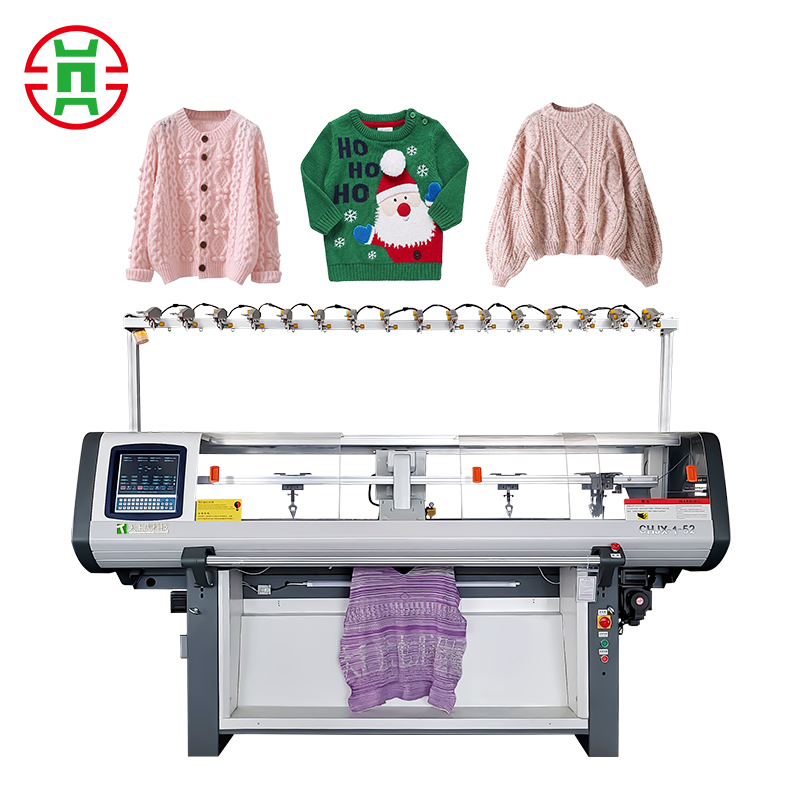
Technical Highlights:
Dedicated Complex Stitch Capability: Optimized for intricate patterns requiring frequent stitch transfers
Extended Working Width: 72-inch bed accommodates large panels while maintaining stitch quality
Advanced Software Interface: Streamlined programming reduces operator training time
Ideal Applications: High-fashion knitwear, technical textiles, and specialized production requiring maximum pattern flexibility
Need precision for complex designs? Explore our 72-inch Single System Machine specifications.
The optimal balance of speed and versatility for medium to high-volume production environments.
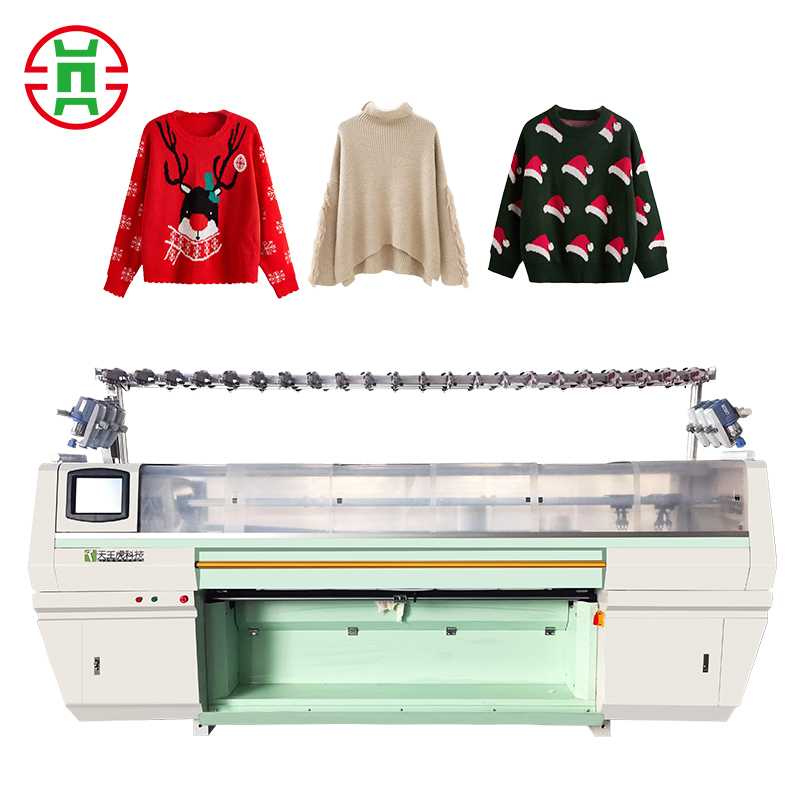
Technical Highlights:
Dual-System Efficiency: Knits in both directions for significantly increased production speed
Enhanced Working Width: 80-inch bed provides additional flexibility for larger garments
Vibration-Dampened Carriage: Ensures smooth operation at high speeds for consistent quality
Ideal Applications: Volume production of fashion knitwear, basic sweater styles, and mixed-complexity manufacturing
Ready to boost your production capacity? Review our 80-inch Double System Machine capabilities.
For manufacturers demanding maximum throughput and advanced production capabilities.
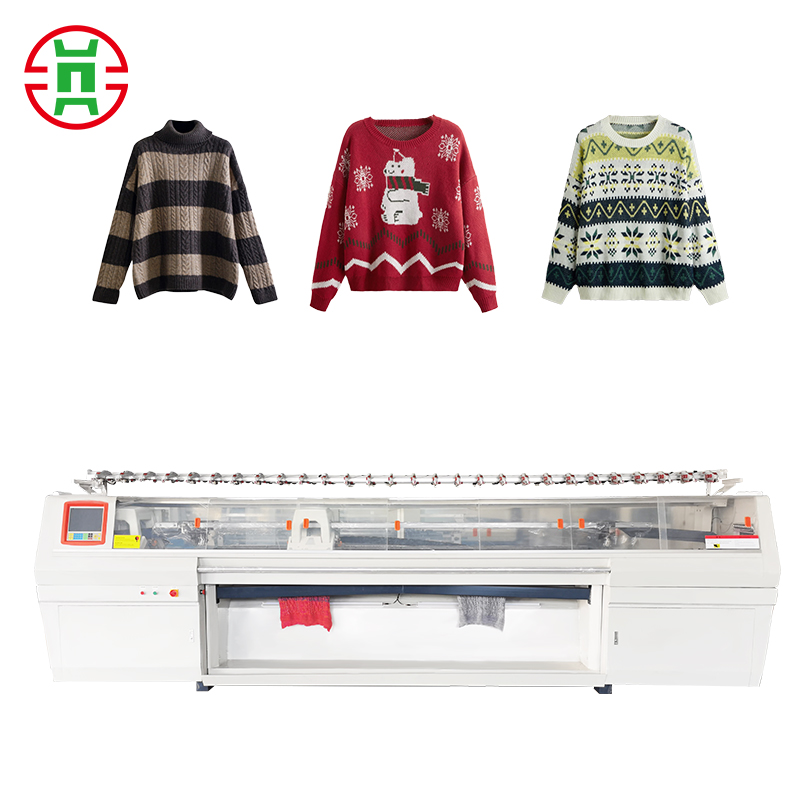
Technical Highlights:
Four-System Architecture: Unprecedented production capacity for whole garment and large-panel knitting
Industrial-Scale Width: 120-inch bed enables multiple garment production or oversized items
Enterprise-Grade Software: Handles the most complex whole garment and 3D knitting programs
Ideal Applications: Large-scale sweater manufacturing, blanket production, technical textiles, and whole garment specialists
Require industrial-scale production? Investigate our 120-inch 2+2 System Machine features.

Investing in Changhua technology delivers measurable business outcomes that extend far beyond the production floor.
Accelerated ROI: The combination of increased throughput, reduced labor costs, and minimized waste typically delivers full investment recovery in 12-18 months
Enhanced Competitive Positioning: The capability to produce complex designs reliably opens premium market segments and customers
Reduced Operational Risk: Decreased dependence on scarce skilled labor while improving production predictability
Sustainability Benefits: Precision manufacturing reduces material waste by 15-25%, while energy-efficient drives lower power consumption
The manufacturing landscape is shifting irrevocably toward automation. Factories that adopted computerized technology pre-pandemic weathered supply chain disruptions more effectively and recovered faster. The competitive advantage automation provides continues to grow as labor markets tighten and customer expectations escalate.
Postponing your automation strategy doesn't just delay benefits—it increases the risk of being permanently disadvantaged against automated competitors.
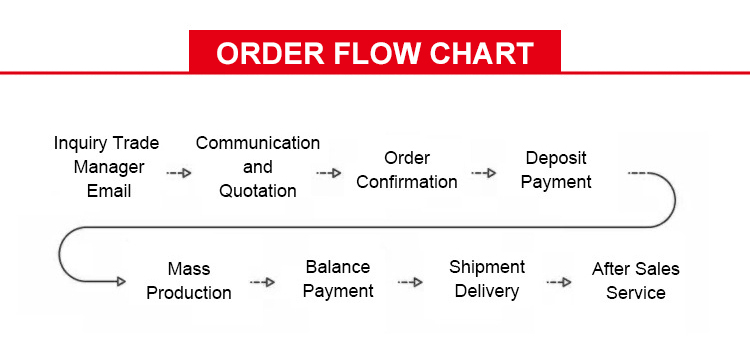
We understand that equipment investment represents a significant strategic decision. That's why we've structured our engagement process to provide maximum information and minimum risk.
We recommend a structured approach:
Technical Assessment: Download our detailed specification sheets and compare machine capabilities against your production requirements
Visual Demonstration: Access our video library to see Changhua machines operating in real manufacturing environments
Customized Analysis: Schedule a consultation with our technical team for a personalized assessment of which machine configuration best suits your needs
ROI Projection: Work with our specialists to develop a detailed return-on-investment analysis specific to your operation
The journey to 30% higher output and sub-1% defect rates begins with a single step.
The question isn't whether you can afford to automate, but whether you can afford to wait.
Connect with Our Technical Team for a Customized Productivity Assessment