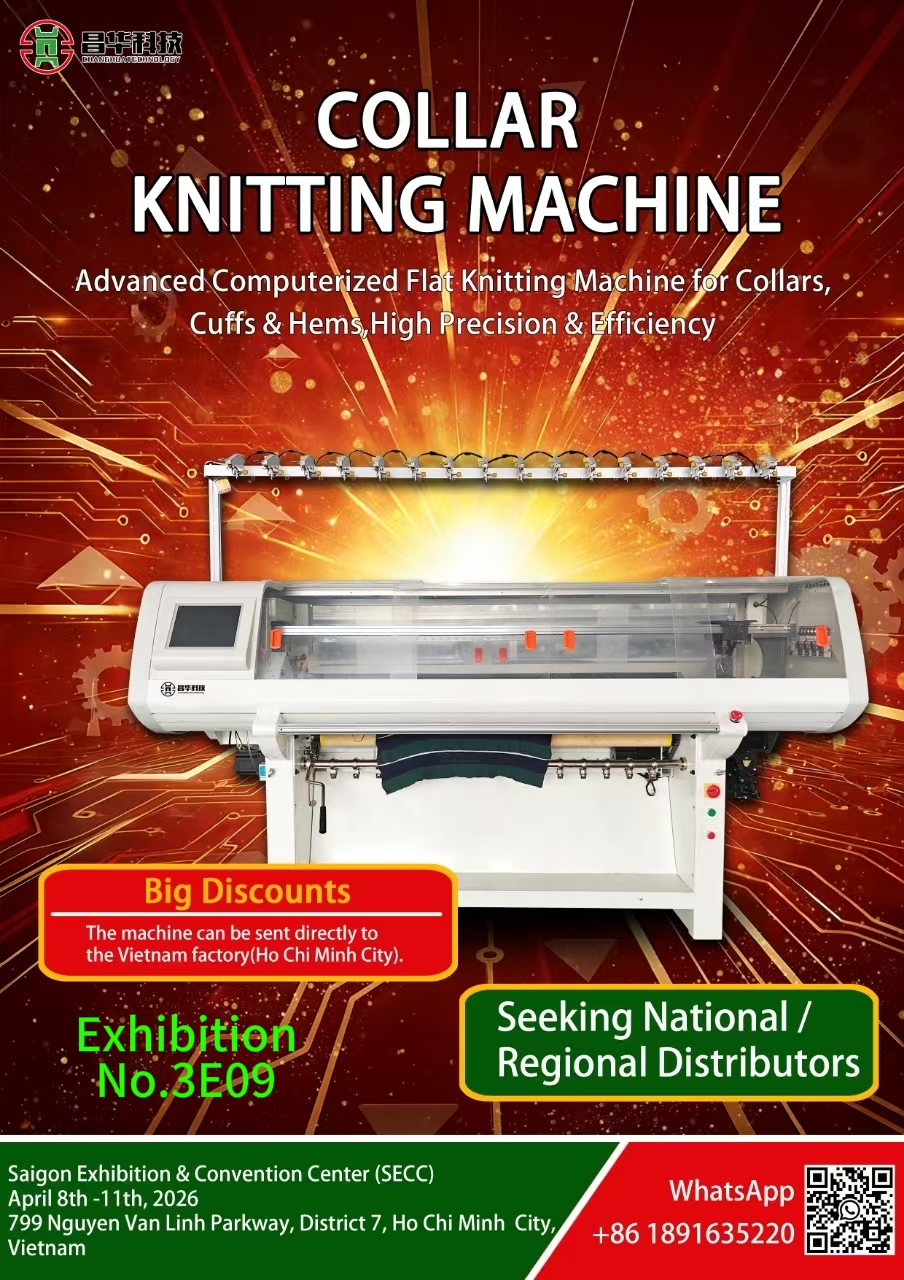
Collar Knitting Machine manufacturer
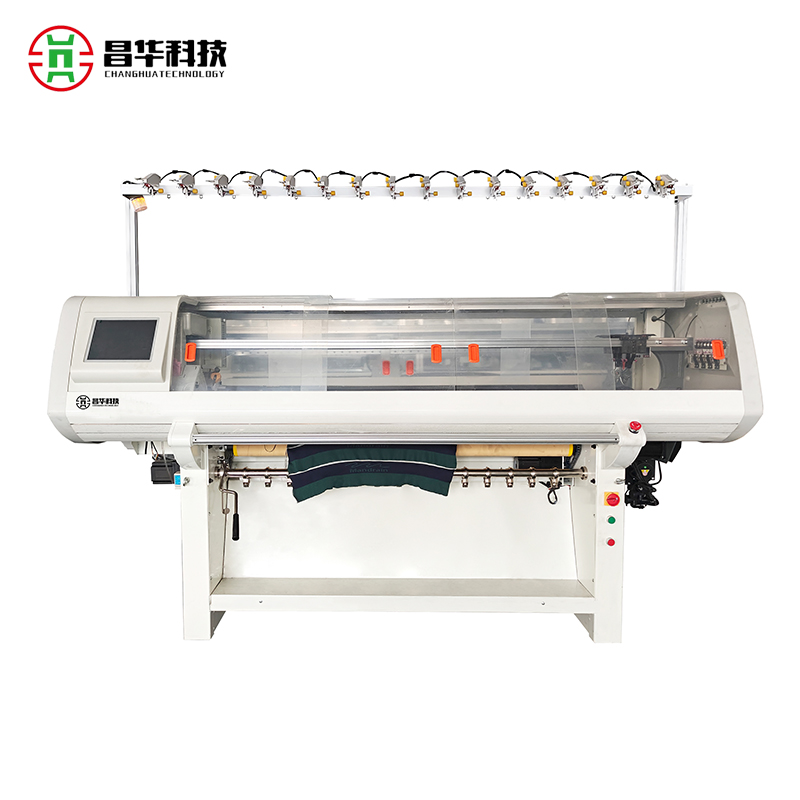
68 Inch Double System Collar Knitting Machine
Research on the Computerized Collar Knitting Machine for Expanding the Mechanical Industry Market in Vietnam
Against the backdrop of the restructuring of the global textile industrial chain, Vietnam has become the world’s third-largest textile exporter thanks to its unique geographical location, abundant labor resources and preferential trade policies. In 2025, Vietnam’s textile and garment industry achieved exports of USD 46 billion, a year-on-year increase of 5.6%, with a trade surplus of USD 21 billion, playing a pillar role in the country’s trade balance. As Vietnam’s textile industry upgrades toward automation and intelligent manufacturing, demand for high-end Collar Knitting Machine ( collar-making machinery ) is surging.
Computerized flat knitting machines are core equipment for manufacturing POLO shirt collars, and their technological advancement directly determines garment quality and production efficiency. At present, Vietnam’s local Collar Knittingmanufacturing sector is underdeveloped, and 60% of its textile raw materials are imported from China, creating huge market opportunities for Chinese Collar Knitting Machineenterprises.
This paper conducts an in-depth analysis of the technical features of computerized flat knitting machines for collar production and the current demand in the Vietnamese market, and proposes targeted marketing strategies to provide decision-making references for Chinese enterprises looking to expand into the Vietnamese market.
Changhua Product Core Advantages: Precisely Aligned with Vietnam Market Demands
Technology and Quality Strength
Changhua has dedicated 20 years to the computerized flat knitting machine industry and has participated in the development of China's textile industry standards.
Specialized collar knitting machines and dual-purpose sweater & collar knitting machines.
Standard models include (e.g., 52-inch and 80-inch); special models such as extended double-head machines (e.g., 80-inch and 100-inch) are also available.
Capable of jacquard pattern knitting and equipped with transfer (flip) needle technology.
Standard gauges: 14G, 16G, 18G. Special gauges are available upon request (please consult us for details).
Special exhibition pricing available (please inquire via form). We are currently seeking Vietnamese agents. High cost-performance ratio with sample development support.
Changhua is a direct manufacturer of collar knitting machines. We support both on-site factory visits and online video inspections.
Perfectly aligned with Vietnam’s market structure, which is dominated by small and medium-sized factories.
With China’s complete industrial supply chain advantages, we ensure short delivery times and fast spare parts supply. Our 24-hour after-sales response and localized installation & commissioning services significantly outperform the 3–5 day service cycles of many European and American brands.
User-friendly operation and beginner-oriented design match the technical level of Vietnamese factory operators, effectively reducing training costs and operational expenses.
The crisp finish on a polo shirt, the perfect edge on a sweater—they all start with one ingenious device: Collar Computerized Flat Knitting Machine. But what makes these machines so special, and why are they essential in garment manufacturing? China Top 5 Collar Knitting Machine Manufacturer. Let’s dive in and unravel the details.
v
What Is a Collar Knitting Machine?
A flat collar knitting machine is a specialized piece of textile equipment designed to knit collars for garments like t-shirts, polo shirts, and sweaters. These machines are engineered for precision and efficiency, producing consistent designs at scale.
Key Applications in the Textile Industry
From casual wear to high-fashion apparel, collar knitting machines are crucial for creating high-quality, customizable designs that meet the diverse demands of the global textile market. They’re a game-changer for any manufacturer aiming for scalability and style.
I. Technical Analysis of Computerized Circular Knitting Machine Collar Products
1.1 Core Working Principles and Technical Architecture
Computerized circular knitting machines utilize a microprocessor control system as their “brain,” translating intricate pattern designs into precise machine instructions. Through a sophisticated needle selector, each needle's lifting trajectory is directed, working in tandem with sinker plate coordination technology to precisely knit three-dimensional structures within a spatial framework. This digital control technology has fundamentally transformed traditional manual neckline shaping and sewing production methods, achieving a technological leap from experience-dependent craftsmanship to programming-driven precision.
In producing polo shirt collars, Collar Knitting Machine ( computerized circular knitting machines ) demonstrate unique technical advantages. The machines achieve one-piece forming of complex patterns and structures, eliminating the uneven seams or stretching deformations inherent in traditional hand-sewn methods. Through three core processes—precise yarn control, stitch gauge adjustment, and three-dimensional shaping—these machines construct three-dimensional collar structures with accuracy down to 0.2 millimeters.
1.2 Key Technical Parameters and Performance Indicators
Based on mainstream market product specifications, the core technical parameters of computerized flat knitting machines are as follows:
Technical Parameter Categories | Specific indicators | Technical advantages |
Pitch density | 15G - 24-pin | Improves fabric density by 100% compared to a conventional 6-needle machine |
Weaving speed | Maximum speed: 1.2m/s, with 24 adjustable sections | AC servo motor precise control |
Weaving width | 68 inch, 80 inch, 100 inch, 120 inch | Meet the requirements of different specifications |
Control system | LCD industrial display, touchscreen interface | Supports USB and network transmission, with 1G of memory. |
Needle bed displacement | Maximum 2 inches, precise adjustment | AC Servo Motor Control |
Spout configuration | 2×8 nozzle groups, 4 guide rail design | Can be switched at any position on the needle bed |
In terms of density control, the advanced computerized flat knitting machine uses stepper motors for control, offering 24 density options and a range of adjustment from 0 to 650 degrees. This enables more precise control of the length of the fabric pieces. The drop piece system is also controlled by stepper motors and can be adjusted according to different weaving materials, achieving various needle-pulling and needle-releasing effects.
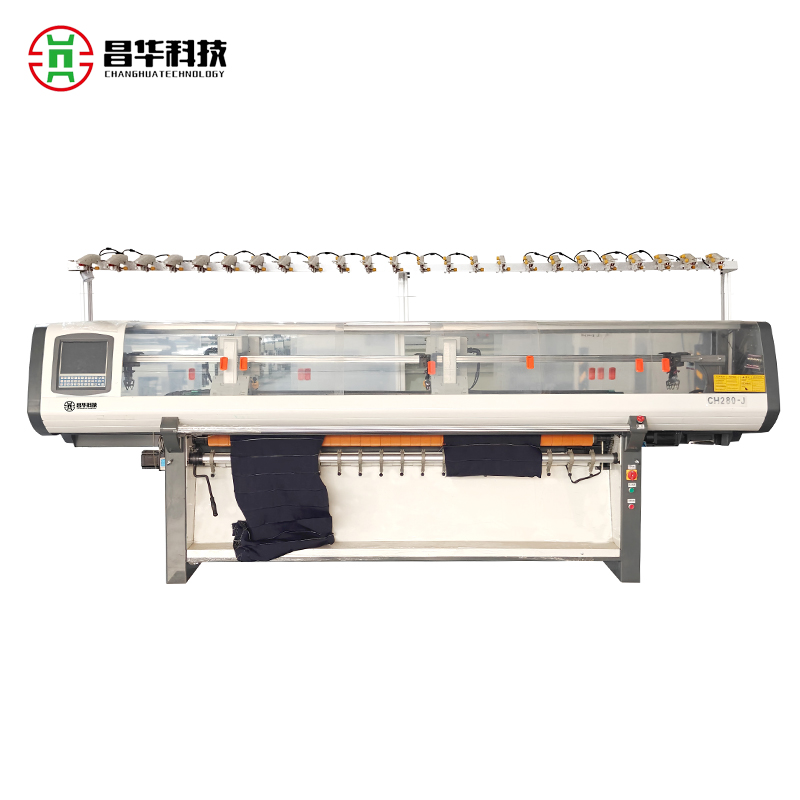
1+1 collar flat knitting machine

1.3 Integrated Precision Knitting Technology
The core competitiveness of the computer cross-stitch machine lies in its integrated forming technology. This technology integrates multiple innovative processes:
The precise needle spacing design adopts a high needle spacing configuration of 12 needles per inch or more. Through dual-system triangular base synchronous control of the front and rear needle beds, it ensures the uniformity of 20 coil rows per inch. In terms of yarn tension control, high-end models such as German Meyerix C3.2 are equipped with electronic guide hammers, which monitor the yarn tension fluctuations (ranging from 2 to 5 cN) in real time and automatically compensate through servo motors within 0.1 seconds. Taking 32S combed cotton as an example, the tension deviation needs to be controlled within ±0.3 cN.
The three-dimensional Cube forming technology is a key innovation that distinguishes it from traditional flat cutting. The collar area adopts the draw-punching process, gradually reducing from full stitches to 60% of the stitch count to form a natural inward curvature; at the front pocket area, a 1×1 ribbed jacquard structure is embedded to enhance 7% longitudinal elasticity and prevent folding deformation; during the 190℃ steam setting process, shape memory additives are implanted to stabilize the tip of the collar peak at 75° ± 2°.
1.4 Brand Structure and Product Positioning
The global computer loom market is dominated by three major players. German Stoll, Japanese Shima Seiki, and Chinese Cizheng and Chinese Changhua are collectively ranked among the top four in the world. In 2010, Cizheng completed its shareholding system reform and acquired the Swiss Sitang, which has a 60-year history of loom manufacturing. Since then, it has entered the top ranks of the industry.
In terms of technical level, different brands have their own characteristics. Stoll adopts its self-developed MDS 7.0 platform, integrating real-time tension closed-loop feedback and multi-axis synchronous servo algorithms, enabling the one-time weaving yield of complex patterns to reach 99.1%; Shima Seiki's APEX 4.0 system deeply integrates the AI image recognition module, which can automatically correct color differences and structural deviations during weaving, and keeps the rework rate within 0.7%.
In terms of price positioning, the market shows a clear hierarchical structure. According to market research, the price of ordinary computer looms ranges from several thousand yuan to tens of thousands of yuan, while high-end products such as Cizheng's most expensive model can cost up to 55,000 yuan. Imported brands have higher prices, such as the international market price of the 1+1 double-head single-system computer jacquard neck machine being 4,900-5,000 US dollars.
II. Current Situation of Vietnam's Clothing Industry and Analysis of Demand for Sewing Machinery
2.1 Development Trend of Vietnam's Textile and Clothing Industry
The Vietnam textile and clothing industry is currently experiencing rapid growth and has established an important position in the global supply chain. From January to September 2025, Vietnam's total textile and clothing exports reached 34.8 billion US dollars, increasing by 7.7% year-on-year. Among them, garment exports reached 27.8 billion US dollars, and the estimated annual export volume is expected to reach 46-48 billion US dollars. Vietnam's textile and clothing products have been sold to nearly 140 countries and regions, maintaining the third-largest export position in the global textile and clothing industry.
From the perspective of the industrial structure, Vietnam's textile industry shows a clear outward-oriented characteristic. In 2025, the Vietnam Textile Group (Vinatex) achieved a revenue of 188.9 trillion Vietnamese dong, completing the annual target by 103.2%. The trade surplus of the industry reached 21 billion US dollars, and the domestic value-added ratio was approximately 52%, indicating an improvement in the self-sufficiency of raw material supply.
It is worth noting that Vietnam's textile industry is currently facing a critical transformation period of industrial upgrading. The rise of the global fitness trend has reshaped the order structure of Vietnam's textile industry. A few years ago, Vietnamese factories mainly undertook low-value-added orders such as ordinary T-shirts, but now orders for yoga clothes, sports clothes, etc., which require special functional fabrics, have significantly increased. This transformation from "quantity" to "quality" has raised higher requirements for the technical level of sewing machinery.
2.2 Development Status of POLO Shirt Production in Vietnam
Vietnam has become a significant global producer of POLO shirts. According to industry research, professional POLO shirt manufacturers in Vietnam have considerable monthly production capacity. For instance, a major manufacturer has a monthly production capacity of 50,000 T-shirts, 30,000 POLO shirts, 20,000 jackets, and 15,000 dresses. These manufacturers are mainly concentrated in major economic regions such as Ho Chi Minh City, Hanoi, and Da Nang.
Vietnamese POLO shirt production enterprises have adopted relatively advanced production processes. According to industry analysis, modern POLO shirt production involves four main steps: design and sample making, cutting (using automatic loom and intelligent cutting machines), sewing (using an intelligent hanging system to distribute fabric pieces, including sewing, stitching, collar attachment, embroidery, side seam sewing, etc.), and post-processing (removing thread ends, quality inspection, and high-temperature ironing for shaping).
However, the POLO shirt manufacturing industry in Vietnam also faces the challenge of rising labor costs. With the rapid development of the Vietnamese economy, the wage levels of workers have continued to rise, which prompts enterprises to accelerate the pace of investment in automated equipment. At the same time, the increasing quality requirements of international brands are also driving Vietnamese clothing manufacturers to seek more advanced production equipment.
2.3 Demand Trends for Computer Flat Weaving Machines in Vietnam
The demand for computer flat weaving machines in Vietnam is experiencing an explosive growth. According to the latest data, the number of computer flat machines imported by Vietnam from China has significantly increased. In May 2025 alone, 2 units of equipment were imported, valued at 24,758 US dollars. More importantly, the export volume of computer flat machines from China to Vietnam increased by 14.3% year-on-year, accounting for 31.7% of China's total export volume.
The main drivers of the demand growth include:
Automation upgrade demand:
The mechanization demand in Vietnam's textile industry is entering an explosive period. A manager of a towel factory in Hanoi said:
"Among the 100+ factories in the factory area, most still rely on manual labor. We urgently need Chinese equipment to increase production capacity." This urgent demand for automated equipment has created a huge market space for computer flat weaving machines.
Technical upgrade pressure:
As international brands raise their quality requirements, Vietnamese garment manufacturers must improve their production technology levels. The integrated forming technology of computer flat machines can significantly improve the quality stability of collars, meeting the quality requirements of high-end brands.
Industrial transfer opportunities:
The reconfiguration of the global textile industry chain has brought a large number of orders to Vietnam. Many POLO shirts originally produced in China have been transferred to Vietnam, and these orders usually have higher requirements for production equipment, driving the demand for advanced collar-making machinery.
2.4 Analysis of the Import Market for Textile Machinery in Vietnam
The import market for textile machinery in Vietnam is highly dependent on imports. In 2024, the total import value of machinery in Vietnam reached 179.88 billion US dollars, with China being the largest supplier, accounting for 53.4% of Vietnam's total imports. In the field of textile machinery, the advantages of Chinese enterprises are more pronounced. Chinese exhibitors accounted for 70% of the exhibitors at the Vietnam textile machinery exhibition.
From the perspective of the import product structure, the demand for high-end textile machinery in Vietnam has grown particularly rapidly. Vietnam's equipment import rates in the fields of metallurgy, automobiles, and electronics exceed 90%, with annual import value exceeding 100 billion US dollars. Chinese enterprises have already occupied a dominant position in areas such as CNC machines, accounting for 65% of Vietnam's imports.
In terms of tariff policies, Vietnam has implemented preferential policies for the import of textile machinery. In 2026, the import tariffs on four core equipment categories, including high-end dyeing equipment, low-emission dyeing production lines, and textile wastewater treatment equipment, will be reduced from 12% to 3.9%. Enterprises can enjoy an additional 5% tax credit with a technical renovation filing certificate issued by the Vietnam Textile and Apparel Association (VITAS), valid until 2030.
III. Competitive Landscape Analysis: Chinese Products vs. Local Vietnamese Products and Other Imported Competitors
3.1 Current Situation of Domestic Manufacturing Industry of Agricultural Machinery in Vietnam
The domestic mechanical manufacturing industry in Vietnam is relatively weak, mainly consisting of small-scale processing enterprises. According to industry research, local manufacturers in Vietnam include companies such as Truong Phung Machinery Company Limited, but these enterprises mainly engage in simple mechanical processing and assembly, lacking core technologies and brand names.
The main disadvantages of local enterprises in Vietnam are as follows:
Lagging technological level:
Local enterprises in Vietnam have a significant gap compared to international advanced levels in core technologies such as precision manufacturing and digital control. Most enterprises still use traditional mechanical processing methods, with a low level of automation.
The industrial chain is incomplete:
Vietnam has limited capabilities in manufacturing high-end components. Key components such as servo motors, control systems, and precision sensors are mainly imported. This incomplete industrial chain hinders the technological upgrading of local enterprises.
Insufficient brand influence:
The domestic manufacturing machinery brands of Vietnam lack recognition in the international market and struggle to gain the trust of high-end customers. In contrast, international brands such as Stoll from Germany and Isen from Japan have significant advantages in terms of technological advancement and brand recognition.
3.2 Analysis of Main Imported Competitors
In the Vietnamese construction machinery market, the main imported competing products come from the following countries:
German brands:
Represented by Stoll, their products have the highest technical content. They adopt their own self-developed MDS 7.0 platform, integrating real-time tension closed-loop feedback and multi-axis synchronous servo algorithms. The one-time weaving yield of complex patterns reaches 99.1%. The advantage of German equipment lies in its advanced technology and stable quality, but it is expensive, usually being 2-3 times that of domestic equipment.
Japanese brands:
Represented by Shima Seiki, its APEX 4.0 system integrates an AI image recognition module, which can automatically correct color differences and structural deviations during weaving, with the rework rate controlled within 0.7%. Japanese equipment has advantages in terms of precision and intelligence, but it also faces the issue of high prices.
Korean brands:
Korean enterprises entered the Vietnamese market earlier, but in recent years they have faced profit compression and tariff risks, and some of them have planned to withdraw from the Vietnamese market. The characteristics of Korean equipment are that it has a relatively high cost-performance ratio, but it is slightly inferior to that of Germany and Japan in terms of technological advancement.
Chinese brand:
Core advantages of Changhua products: Precisely matching the market demands of Vietnam
Technology and quality compatibility:
Changhua has been deeply involved in the field of computer flat knitting machines for 25 years. It has participated in the formulation of China's textile industry standards. The manufacturing standards for core components (needle bed, triangle) are higher than the industry standards, with outstanding stability, durability, and uniformity of stitch patterns, which meet the core demands of Vietnamese factories for low failure rates and high product quality. The products cover a full range from 1.5G to 24 needles, meeting the complete product requirements of Vietnamese factories ranging from low-end outsourcing to high-end brands. The products cover a full range from 1.5G to 24 needles, meeting the complete product requirements of Vietnamese factories ranging from low-end outsourcing to high-end brands.
3.3 Competitive Advantages of Chinese Products
Chinese-made agricultural machinery enjoys multiple competitive advantages in the Vietnamese market:
The price advantage is significant:
The prices of Chinese machine tools are 20% - 30% lower than those of products from Europe, America, Japan and South Korea. However, their quality has reached international standards (such as ISO 9001 certification), and can meet the demand for "high value for money" in the Vietnamese market. This price advantage is particularly attractive to budget-conscious small and medium-sized enterprises in Vietnam.
Supply chain advantages are prominent:
60% of Vietnam's textile raw materials rely on imports from China. The Chinese supply chain is irreplaceable. The technological accumulation and output quality of Chinese enterprises in automated production have led Vietnamese factories to prefer Chinese suppliers even in the face of tariff pressures.
Geographical and cultural advantages:
China and Vietnam are geographically close to each other, and they have natural advantages in cultural exchanges and business cooperation. Chinese enterprises can provide more timely after-sales service and technical support, which is crucial for the normal operation of the equipment.
Improvement in technological innovation capabilities:
Chinese enterprises, such as Chisun, have significantly enhanced their technological levels by acquiring advanced international enterprises. After acquiring the Swiss company Stang, Chisun has become one of the top three enterprises in the world. Chinese enterprises have maintained their price advantages while continuously increasing the technological content of their products.
3.4 Competitive Strategy Suggestions
Based on the analysis of the competitive landscape, Chinese enterprises should adopt the following competitive strategies:
Differentiation Competition:
Focus on promoting differentiated products with technological advantages, such as high-speed and efficient computer looms, highly intelligent cutting equipment, etc. Through technological innovation, establish a competitive barrier and avoid pure price competition.
Localized services:
Strengthen the construction of the after-sales service network in Vietnam, provide timely technical support and equipment maintenance. Consider setting up service centers in major cities, training local technicians, and improving the service response speed.
Supply chain collaboration:
Make full use of China's advantages in the textile industry chain and establish long-term cooperative relationships with Vietnamese enterprises. We can provide a one-stop solution from raw materials to equipment, enhancing customer loyalty.
Brand building:
Increase the intensity of brand promotion by participating in industry exhibitions and holding technical exchange meetings, etc., to enhance the brand's awareness and reputation in the Vietnamese market.
IV. Suggestions for Market Promotion Strategies in Vietnam
4.1 Product Strategy:
Localization adaptation and technological upgrade
In response to the specific demands of the Vietnamese market, Chinese enterprises should adopt differentiated product strategies:
Develop product specifications suitable for the Vietnamese market:
Considering that the garment manufacturing enterprises in Vietnam are mainly small and medium-sized enterprises, it is necessary to focus on developing mid-range products with moderate prices and simple operation. At the same time, for the high-end demands of large enterprises, provide advanced high-end equipment. The product specifications should cover different needle spacings (12G, 14G, 16G, etc.) and weaving widths (52 inches, 66 inches, 68 feet, 80 feet, 100 feet, 120 feet), meeting the needs of different production scales.
Enhancing the professional functions of the POLO shirt collar:
Based on the production characteristics of POLO shirts in Vietnam, specialized collar-making functional modules have been developed. For example, in response to the requirements of the Vietnamese market for the stiffness and durability of the collar, three-dimensional three-dimensional forming technology can be strengthened to ensure that the tip of the collar remains stable at 75° ± 2°. At the same time, breathable collar weaving technology suitable for tropical climates has been developed.
Intelligentization and Automation Upgrade:
In line with the trend of automation upgrading in Vietnam's textile industry, we focus on promoting intelligent equipment with Internet of Things capabilities. Each flat knitting machine can be equipped with 200 sensors, which can upload 18 parameters such as coil length and yarn consumption in real time to the MES system. This intelligent function can help Vietnamese enterprises achieve precise control of the production process and quality traceability.
4.2 Channel Strategy: Diversified Layout and Localized Operations
Establish a three-dimensional sales channel network:
Participating in professional exhibitions:
Actively participated in professional exhibitions such as the Vietnam International Textile and Apparel Industry Exhibition (SaigonTex). This exhibition is an UFI-certified event with the greatest influence in the textile and apparel industry in ASEAN. In 2025, it attracted 1,068 exhibitors from 24 countries and regions, with Chinese enterprises accounting for 718. Through the exhibitions, one can directly contact target customers and showcase product advantages.
Utilizing B2B platforms:
Make full use of local B2B platforms in Vietnam, such as the top-ranked B2B wholesale platform in Vietnam, which connects global buyers with local high-quality suppliers and covers 1,000+ categories including agriculture, textiles, furniture, electronics, etc. At the same time, utilize professional platforms like Made-in-China.com to publish product information and attract Vietnamese buyers.
Establish an agency system:
Set up agents or distributors in major cities in Vietnam such as Ho Chi Minh City, Hanoi, and Da Nang. Select local enterprises with a background in the textile industry, sufficient customer resources, and technical service capabilities as partners.
Developing the direct sales model:
For large clients, the direct sales model can be adopted, where direct communication is established with the company's top management to provide customized solutions. This model enables a better understanding of customer needs and offers more professional services.
4.2 After-sales Service Strategy: Rapid Response and Technical Support
Establish a comprehensive after-sales service system:
Set up service outlets: Establish after-sales service centers in major cities such as Ho Chi Minh City and Hanoi, equipped with professional technicians and common spare parts. The service centers should provide 24-hour hotline services to promptly respond to customers' technical inquiries and fault reporting.
Offer training services: Provide training services for customers on equipment operation, maintenance, and other aspects. Regular training courses can be held to help the operators of the customers master the correct usage methods of the equipment and improve production efficiency.
Establish a remote diagnosis system:
Utilize Internet of Things technology to establish a remote diagnosis system. Through network connections, real-time monitoring of equipment operation status can be conducted, and problems can be detected and solved in a timely manner. This approach can significantly improve service efficiency and reduce service costs.
Establish service standards:
Establish standardized service processes and quality standards to ensure the timeliness and professionalism of the services. Service commitments can be formulated, such as 24-hour response and 48-hour arrival at the site, to enhance customer confidence.
The rapid development of Vietnam's textile and garment industry has created huge market opportunities for computerized loom manufacturing machinery. Through in-depth analysis, the following key conclusions can be drawn:
Broad market prospects:
Vietnam has become the world's third-largest exporter of textiles, with an export volume of 46 billion US dollars by 2025, and the demand for loom manufacturing machinery is experiencing explosive growth. Chinese enterprises, with their advantages in price, supply chain, and geographical and cultural factors, have a significant competitive edge in the Vietnamese market.
Technological innovation-driven:
The integrated forming technology, intelligent control, and precise weaving of computerized looms can significantly improve the quality and production efficiency of POLO shirt collars, meeting the demands of Vietnamese enterprises for high-end equipment.
Clear strategic recommendations:
Chinese enterprises should adopt differentiated competition strategies, focus on promoting technologically advanced products; establish diversified sales channels, strengthen local operations; improve the after-sales service system, provide timely technical support; and also attach importance to compliant operation to prevent market risks.
Looking to the future, as Vietnam's textile industry transforms towards automation and intelligence, the demand for high-end loom manufacturing machinery will continue to grow. Chinese enterprises should seize this strategic opportunity period, through comprehensive measures such as technological innovation, market expansion, and service improvement, establish a stable competitive position in the Vietnamese market, and achieve sustainable development of the enterprise. At the same time, they should also be aware of the intensity of market competition, continuously improve product quality and service levels, and win the trust and support of Vietnamese customers with high-quality products and services.

 English
 العربية
 Français
 Русский
 Español
 Português
 Deutsch
 italiano
 日本語
日本語 한국어
한국어 Nederlands
 Tiếng Việt
 ไทย
ไทย Polski
 Türkçe
 ភាសាខ្មែរ
 Bahasa Melayu
 தமிழ்
தமிழ் Filipino
 Bahasa Indonesia
 magyar
 Română
 Čeština
 қазақ
қазақ Српски
 हिन्दी
 Kiswahili
 Slovenščina
 Norsk
Norsk Svenska
 українська
 Ελληνικά
 Suomi
Suomi עברית
עברית اردو
اردو Shqip
Shqip বাংলা
বাংলা Hrvatski
 Gaeilge
 Māori
Māori සිංහල
සිංහල नेपाली
 Oʻzbekcha
 Aymara
 Azərbaycan dili
 Беларуская мова
 Български
 guarani
 Lietuvių
 Runasimi
 Türkmençe


